
Systematic Investment Plan (SIP): How It Works, Returns, Risks & Strategy (2026 Guide)
In 2026, markets remain volatile, investor emotions remain fragile; yet one strategy continues to outperform the behavioural mistakes:
The Systematic Investment Plan (SIP).
At VittaraWealth, SIP is defined as: “Automated equity ownership with discipline.”
Why Most Investors Fail at Wealth Creation?
Despite access to mutual funds, stock markets, and financial apps, many investors struggle with long-term equity investing because they:
-
Timing the market : Attempting to predict highs and lows instead of staying invested.
-
Panic during corrections : Selling when markets crash due to fear, locking in losses.
-
Stop SIPs during downturns : Stopping contributions when markets are down—the worst time to stop.
-
Ignoring compounding : Underestimating the exponential power of long-term consistency.
Wealth isn’t destroyed by markets. It’s destroyed by inconsistent behaviour.

What Is a Systematic Investment Plan (SIP)?
A Systematic Investment Plan (SIP) is a disciplined investment strategy where you invest a fixed amount at regular intervals into mutual funds.
Why SIP Investment Strategy Works:
Fixed monthly investing
Long-term compounding
Emotion-free automation
Goal-based structure
Think of SIP as an EMI for wealth creation.
Power of Compounding: 10x Wealth Creation Example
If you invest:
₹1,000 per month
For 30 years
At 12% expected return
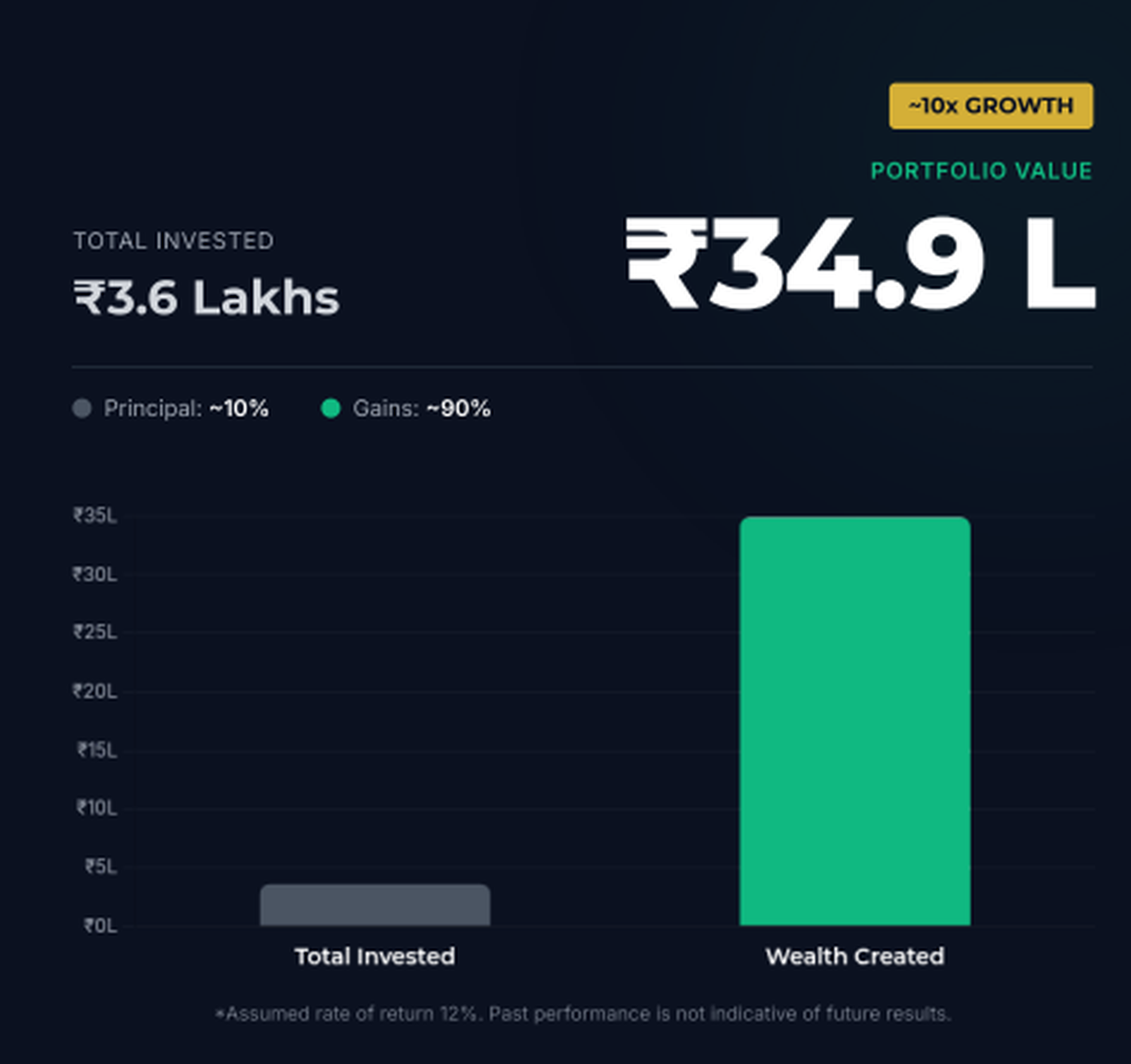
Total investment: ₹3.6 Lakhs
Expected Return: ~₹34.9 Lakhs
Nearly 10x growth.
This demonstrates why the power of compounding is the backbone of long-term SIP returns in India.
SIP During a Market Crash: While Volatility Becomes Your Friend
Most investors fear market crashes.
But for disciplined SIP investors, volatility creates opportunity.
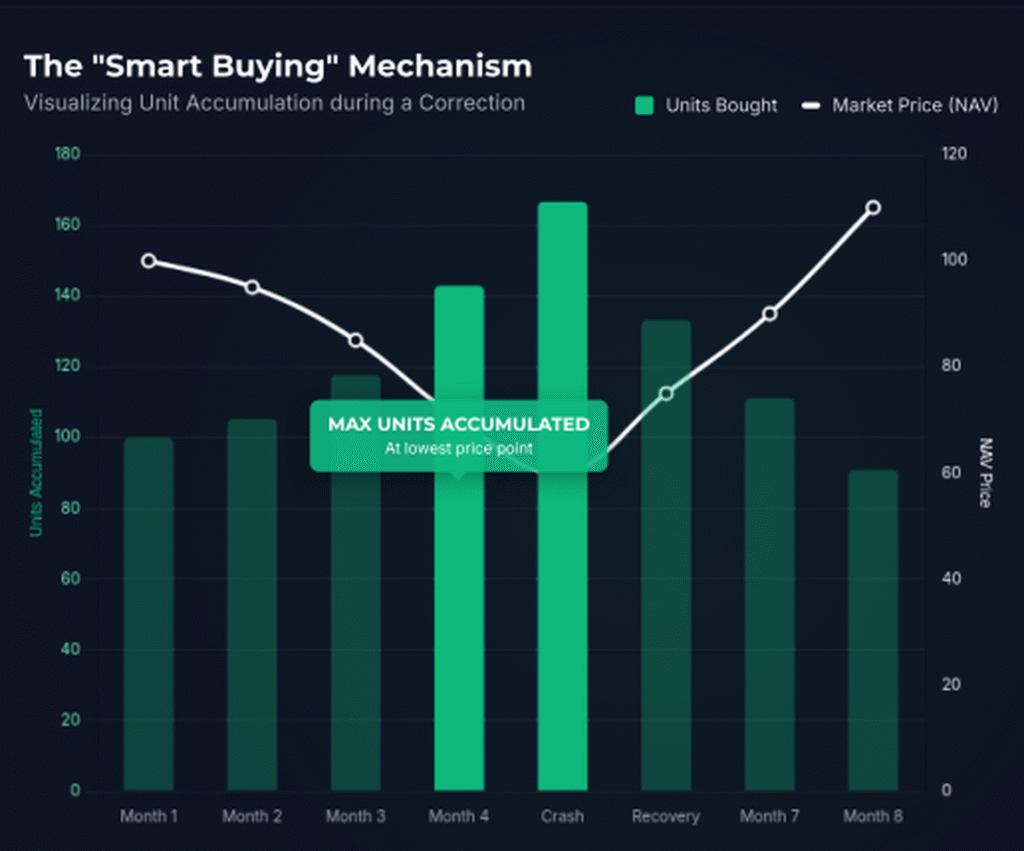
During a Market Fall
You accumulate more units at lower prices.
Every dip allows your SIP to buy investments at a discount.
During Market Recovery
Those accumulated units significantly amplify your returns as markets bounce back.
This is the power of Rupee Cost Averaging in action.
According to Vittara Interpretation
"Market Fall = Discounted Ownership Opportunity"
So,
Stay consistent.
Stay invested.
Let volatility work for you.
What 10 Years of SIP Investing Really Shows (India)
Real data. No predictions. Just discipline.
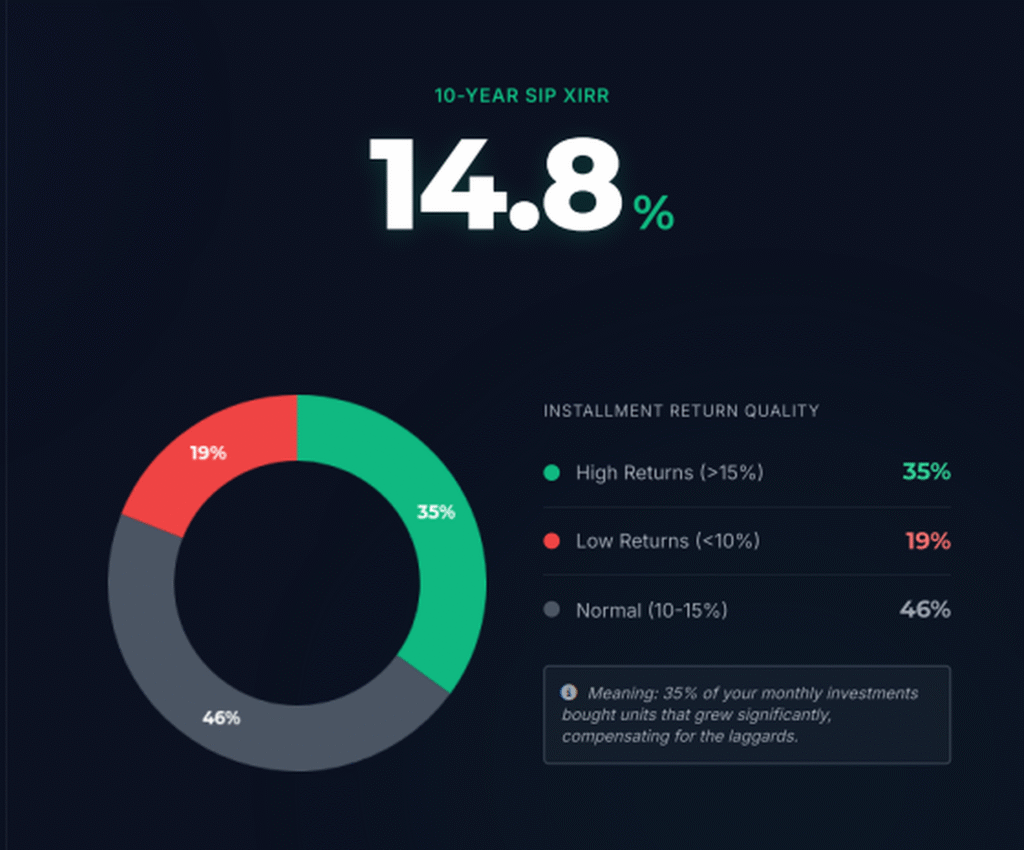
Tracking the Nifty 500 TRI Performance from Feb 2016 to Jan 2026, a disciplined SIP investor achieved a 10-Year SIP XIRR of ~14.8%.
Here’s what happened beneath the surface:
35% of SIP installments delivered strong returns with >15%
Only 19% of months ended with Low returns with >10%
The remaining 46% stayed in the Normal returns 10–15% range
According to our CONCLUSION
Consistency > Prediction
Even with 19% poor months, the portfolio delivered ~14.8% due to rupee cost averaging.
The takeaway:
Consistency beats prediction.
Rather than waiting for the right time.
Mid Cap vs Large Cap SIP: What Time Really Changes
When consistency meets time, outcomes diverge.
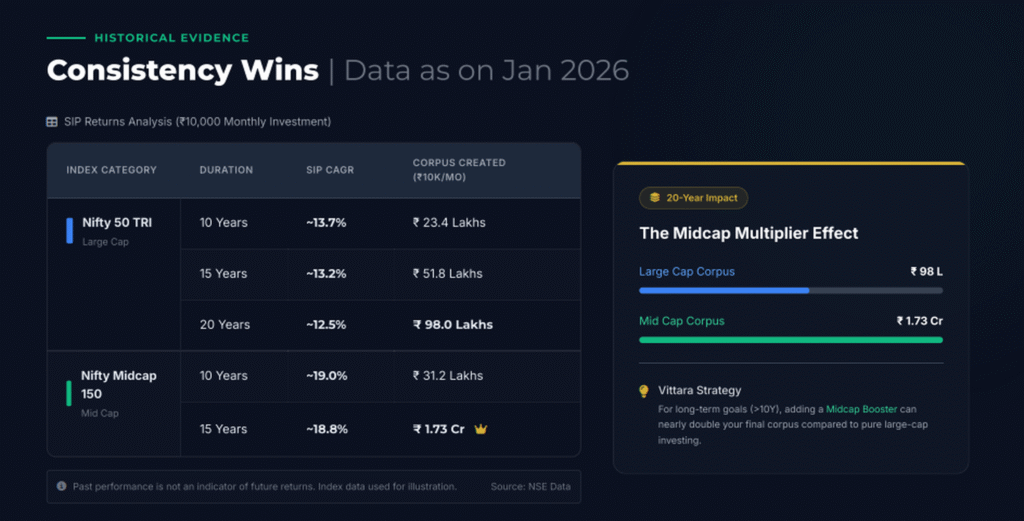
Based on a ₹10,000 monthly Investment on SIP, historical index data shows how compounding plays out across market Caps:
Large Cap (Nifty 50 TRI)
Investment horizon: 20 years
CAGR: ~12.5%
Total returns: ~₹98 Lakhs
Mid Cap (Nifty Mid Cap 150)
Investment horizon: 15 years
CAGR: ~18.8%
Total returns: ~₹1.73 Cr
For long-term goals (>10Y), adding a Mid Cap Booster can nearly double your final returns compared to pure Large-Cap investing.
The insight:
Time + consistency matter.
Allocation matters even more.
Consistency wins. Prediction doesn’t.
Step-Up SIP is seriously underrated
Most people think investing is about picking the right fund.
But what really matters is how you invest.
Let’s look at a simple example.
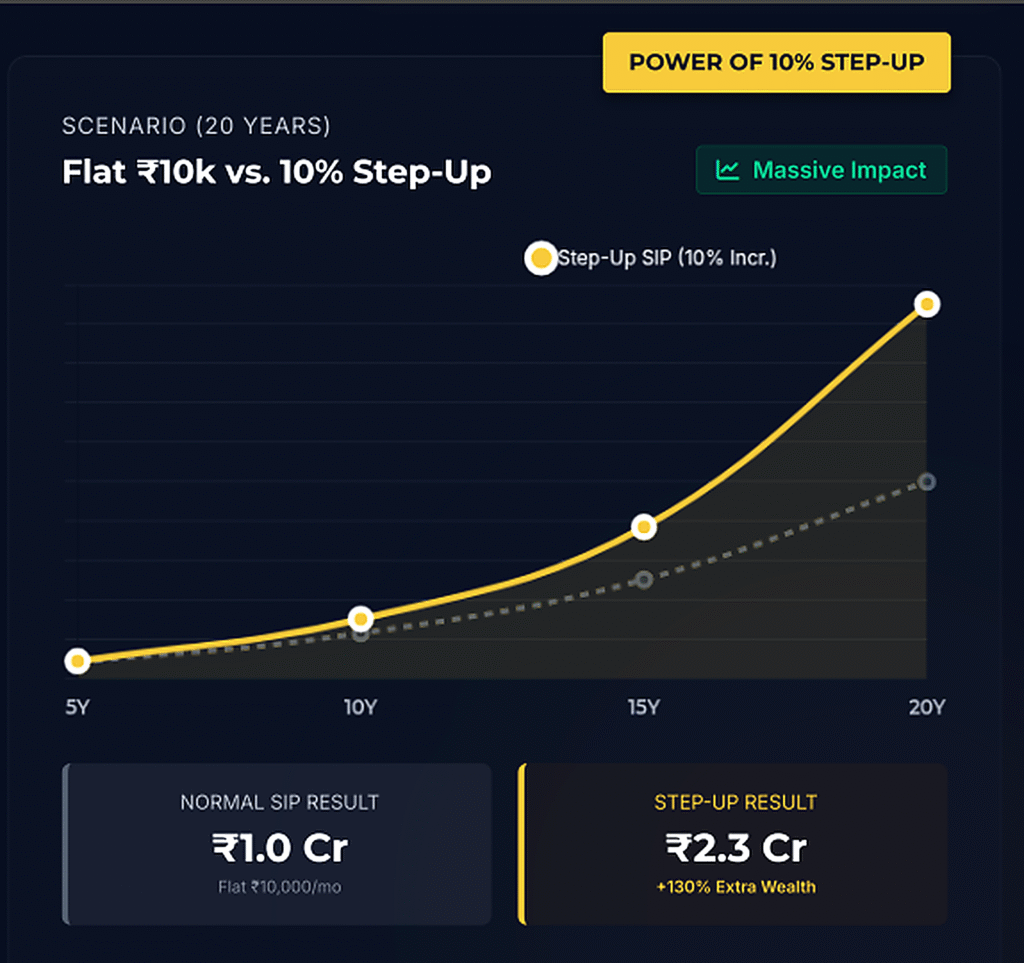
If you invest ₹10,000 every month for 20 years, you’ll end up with roughly ₹1 crore.
Now lets do some small adjustments:
Increase that SIP by 10% every year.
The result?
~₹2.3 crore
About 130% more wealth
Same market. Same funds.
No timing. No predictions.
Just smarter structure.
Why this works
Markets move through three phases:
Bad price zones (fear, panic, corrections)
Good price zones (normal, steady growth)
Great price zones (deep discounts, crisis periods)
With a regular SIP, you automatically buy across all three.
That’s rupee cost averaging.
A Step-Up SIP adds one more advantage:
You invest more money later, when:
Your income is higher
Your confidence is better
So the biggest investments happen when your financial capacity is strongest.
Why Step-Up SIP works in real life
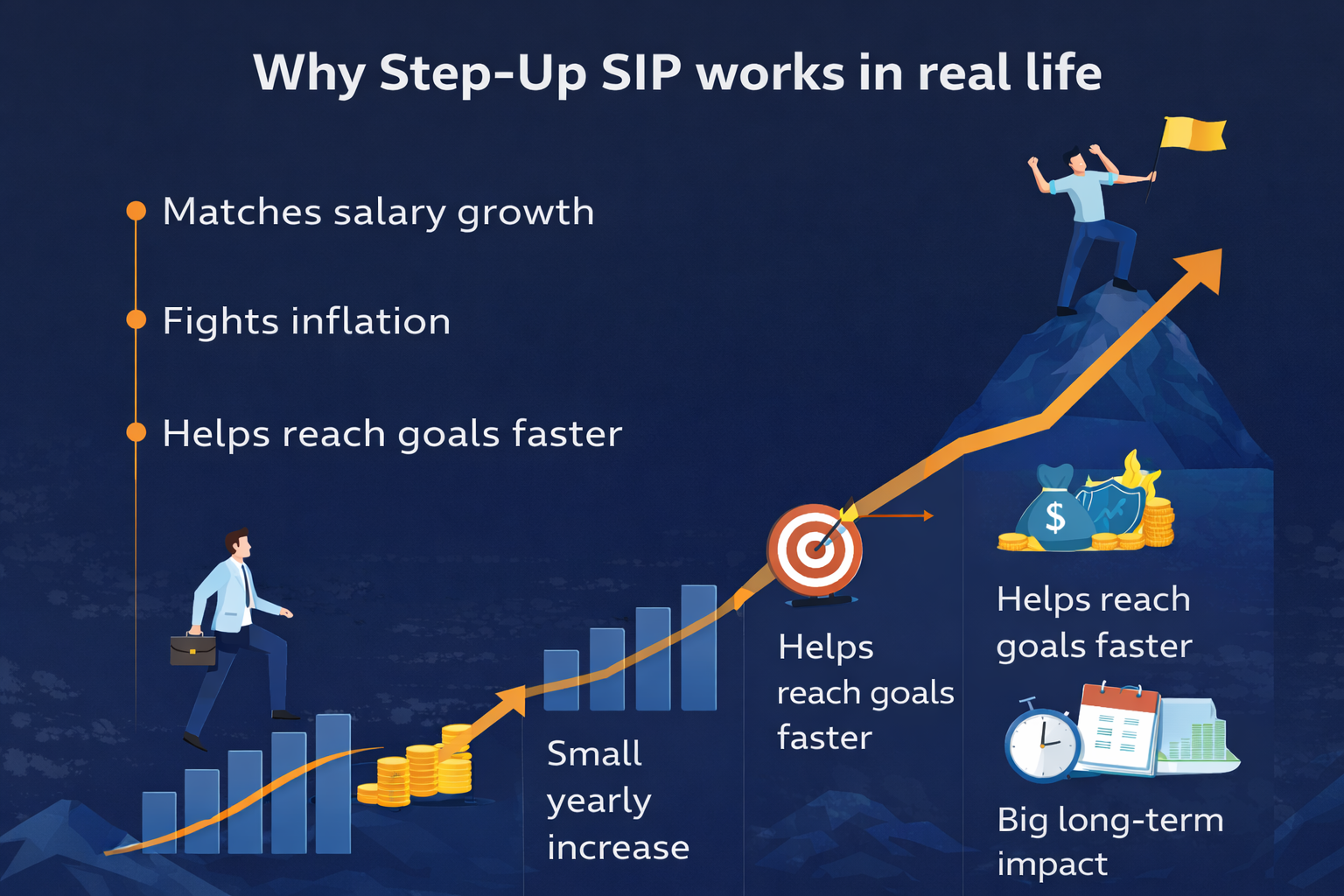
It matches salary growth instead of fighting it.
It protects purchasing power from inflation.
It helps you reach goals faster—often years earlier.
The yearly increase feels small, but the long-term impact is huge.
You’re not trying to outsmart the market.
You’re simply letting time, discipline, and income growth do their job.
According to Vittara Framework The 7–5–3–1 SIP Rule
Long-term investing doesn’t need complex formulas.
It needs the right expectations and enough time.
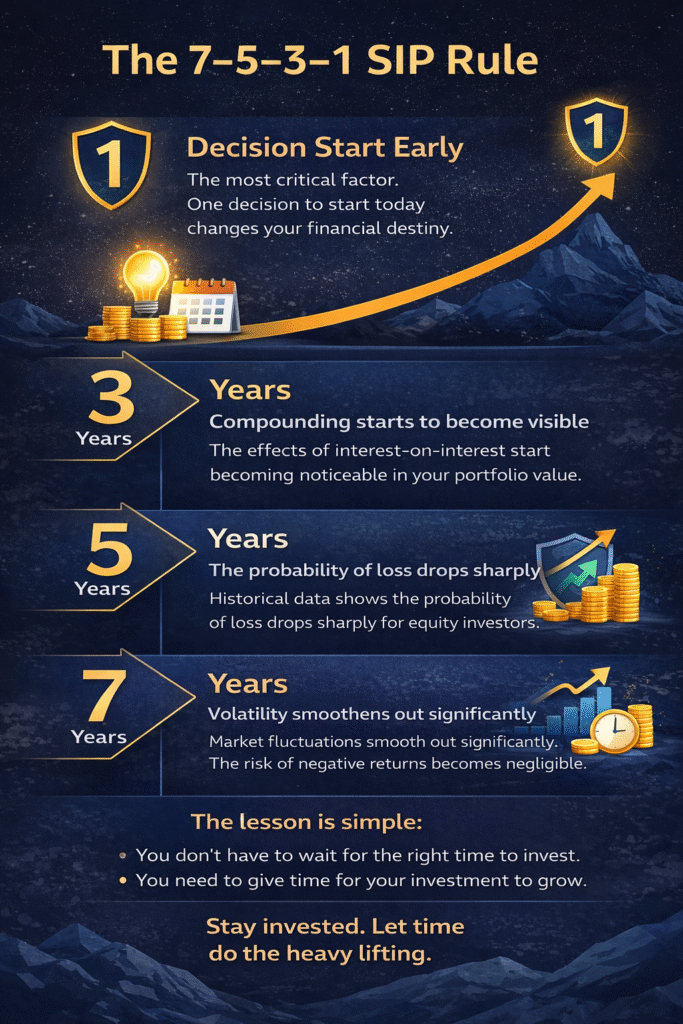
That’s what the 7–5–3–1 SIP Rule is about.
1 Decision
Start Early
The most critical factor. One decision to start today changes your financial destiny.
3 Years
Compounding starts to become visible.
The effects of interest-oninterest start becoming noticeable in your portfolio value.
5 Years
The probability of loss drops sharply.
Historical data shows the probability of loss drops sharply for equity investors.
7 Years
Volatility smoothens out significantly.
Market fluctuations smooth out significantly. The risk of negative returns becomes negligible.
The lesson is simple:
You don’t have to wait for the right time to invest.
You need to give time for your investment to grow
Stay invested. Let time do the heavy lifting.

The VittaraWealth Approach
We don’t believe wealth is built by chasing the “best” SIP.
It’s built by creating systems that compound with your life goals.
Instead of one-size-fits-all products, Vittara focuses on goal-aligned investing frameworks, each designed for a specific stage and purpose:
Child Education
Long-term investing to stay ahead of rising education costs.
TARGET: 15+ yearsRetirement SIP
Building a dependable corpus for financial freedom.
TARGET: 20+ yearsWealth Rocket
Higher-growth strategies for lifestyle upgrades and big milestones.
TARGET: 10+ yearsMid Cap Booster
Selective growth exposure for investors who can handle volatility.
TARGET: 7+ yearsStep-Up SIP (Smart Auto)
Investments that grow automatically as your income grows.
10% annual increment to crush inflation.
How it’s executed (this is where discipline comes in)
Risk Calibration
Matching asset allocation to your psychological risk tolerance.Automation
Removing human emotion via bank mandates & salary-linked triggers.Rebalancing
Systematic profit booking from equity to debt during high valuations.Transparent Reporting
Real-time tracking of goals, not just returns.
Final Thoughts
Markets will fluctuate.
Disciplined investors accumulate.
Wealth is not created in bull markets. It is created by consistency during uncertain times.
Vittara Client advantage:
Systematic Wealth Creation:
Automated discipline removes emotional errors.
Inflation-Beating Growth:
Real returns that protect purchasing power.
Risk-Calibrated Portfolios:
Aligned to your specific life goals and timeline.